
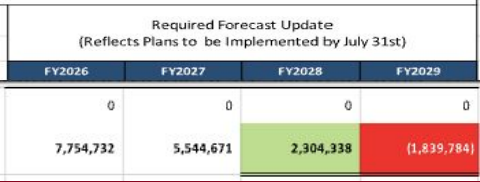
At the December 15, 2025, Board of Education meeting, the NREVSD board officially approved the state-mandated fiscal reduction plan, less than a week before the imposed deadline. The full plan and presentation are available online here.
As part of this plan, NREVSD will make several reductions to services and staff ahead of Fiscal Year 2027. In total, roughly $1.2 million in cuts will be made before Fiscal Year 2027, which starts on July 1, 2026. The cuts compound, growing to roughly $1.46 million in Fiscal Year 2028.
“These cuts, while difficult, help us continue to maintain transportation, all-day Kindergarten, specials such as physical education, art, and music, as well as the bulk of our mental health services,” Superintendent Paul Daniels said. “All of those are crucial areas identified through both our surveys and community meetings.”
The cuts also help the district continue to align staffing and operations with enrollment, needs, and available resources. Specific cuts in this fiscal plan are outlined later in this article.
How did we get here?
Historically, NREVSD has relied on the income from two power plants, Beckjord and Zimmer. As those plants closed and the property's value declined, the burden shifted to taxpayers.
The district relies on local residential property taxes for 85.53 percent of its budget.
As those funds began to wane, the district pivoted. Overall, NREVSD spends roughly $2 million less than it did in 2015. In that time, the district has adjusted staffing levels to declining enrollment. A voluntary incentive package offered last year reduced 10 teaching positions, saving approximately $8 million over seven years.
What comes next?
In the long term, further changes are needed to ensure the district’s financial health. The community survey is still open at bit.ly/NRLevySurvey for community members to share their thoughts and ideas.
Bluntly, the district cannot continue to cut its way out of this deficit while maintaining the current level of services. Without additional tax revenue through a property tax or an income tax, the district will need to take drastic measures to balance the budget.
“We can’t slash a little here, slash a little there,” Mr. Daniels said. “We can’t do this anymore…the board is going to have to consider generating revenue from some sort of voter engagement.”
This includes realignment of buildings, including possibly moving our eighth-grade students to New Richmond High School, and closing another elementary school to reconfigure the district.
It would include further cuts to student services, including the complete elimination of mental health supports and the elimination of high school transportation.
“As we move forward from the submission of our fiscal plan, the board and administration is committed to seeking the input of the NREVSD community and all stakeholders on what we desire our schools to look like into the future,” President Jonathan Zimmerman said. “Additional revenue streams will have to be identified and collected as future cuts would have to be more drastic, yielding a school district that is very different than it currently is.”
Changes for the 2026-2027 school year
Four teaching positions will be reduced through retirements and staffing efficiencies. An additional teaching position will be eliminated due to overstaffing.
One administrative position will be cut on the secondary campus. A transportation employee will be reduced through a reduction-in-force.
Student support staff will have their schedules adjusted to work only when students are in session.
Pay-to-play fees will also increase to $300 per student per sport with no family cap, effective at the beginning of the 2026-2027 school year.
Further reductions come to purchased services. Partial payments toward behavior coaches at Grant Career Center and Locust Corner Elementary schools will be eliminated. A full-time mental health counselor, four county aides, and a school psychologist will also be cut.
“We have approached this through the lens that our community wants everything that we have, but we can’t really afford,” Mr. Daniels said. “People are going to feel it. Our counselors are going to feel it. We feel it in transportation. Our intervention specialists are going to feel it.”
The board has not yet decided whether or when to put another proposal on the ballot. These cuts will keep the district solvent through Fiscal Year 2028, but additional revenue is still necessary.
Some revenue has already been brought in. A shared services agreement with Felicity-Franklin Schools generates $57,000 per year.
A partnership with Grant Career Center to expand vocational opportunities at New Richmond Middle School will generate roughly $145,000 this year and could be expanded next school year.
Additionally, Cincinnati Children’s Hospital pays approximately $35,000 in annual rent for the school-based health center.